Your Operation Changes Every Second. Management Happens Periodically.
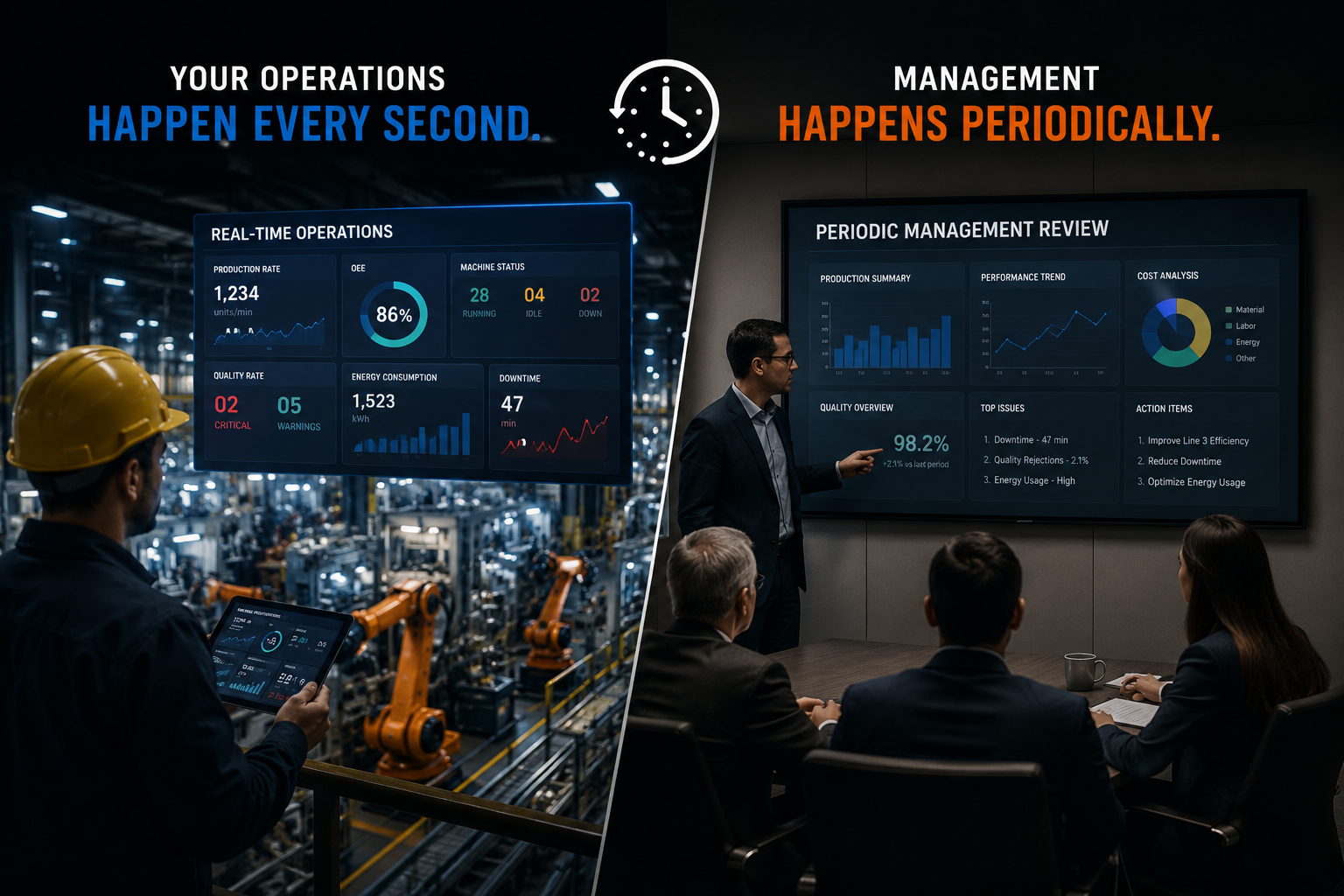
Reality does not operate on reporting cycles.
Machines do not wait for weekly reviews.
Processes do not pause until the next audit.
Human behavior does not align itself with management meetings.
Operations change continuously.
Management happens periodically.
For more than a century, organizations have accepted this gap as normal.
A supervisor observes the floor.
A report is created.
A manager reviews the report.
A decision is made.
The process repeats.
The model worked because there was no alternative.
Continuous awareness was impossible.
So we built management systems around periodic observation.
The challenge is that operations have become dramatically more complex while management practices have remained largely the same.
A manufacturing plant may generate millions of events every day.
A hospital may involve thousands of interactions that influence patient outcomes.
A logistics network may span hundreds of facilities, vehicles, and personnel.
Yet the majority of critical decisions are still based on summaries of reality rather than reality itself.
Dashboards.
Reports.
Audits.
Meetings.
All valuable.
None are reality.
They are interpretations of reality.
And every interpretation introduces delay.
Most operational failures do not occur because organizations lack data.
They occur because something changed before the organization became aware of it.
A safety risk emerged.
A process deviation became routine.
An operational bottleneck developed.
A best practice was discovered and never captured.
By the time the issue appears in a report, reality has already moved on.
This creates a fundamental challenge for modern organizations.
Reality moves continuously.
Awareness moves periodically.
Every operational problem exists somewhere in that gap.
The next generation of operational technology will not be defined by better reporting.
It will be defined by reducing the distance between reality and awareness.
Not replacing people.
Not replacing managers.
Not replacing judgment.
But enabling organizations to understand what is actually happening as it happens.
The industrial era taught us how to scale production.
The digital era taught us how to scale information.
The next era will be defined by something different:
The ability to continuously understand the physical world.
Because your operation changes every second.
The organizations that thrive will be the ones that stop managing it periodically.